I came across a blog last night, shared by a friend on FB, that invited people to write about their breastfeeding journey in 100 words or less. This was an exciting challenge and I wanted to be a part of it but I tend to ramble on and on, as many of you know. How in the world could I ever keep my story to 100 words or less? My journey includes 4 kids, difficulties nursing, tandem nursing, adoption, unexpected pregnancies, forced weanings. It is a very emotional journey for me.
In the end I decided to focus on the emotions I felt in the up and down ride and this is what I came up with. I will be submitting it today and I really hope that they use it. I also hope it's ok that I am sharing it here, I didn't see anything that said I could not share it on my own blog too.
A Breastfeeding Journey of 4....... First time mom, new baby boy..... Nervous, unsure, flat nipples, poor latch, pumping, finger feedings, frustration, trying so hard..... Triumph, he's got it, we're doing it, success...... New life, baby girl, latches on immediately, easy peasy, joyous, content, uneventful..... Surprise, baby girl, adoption, tandem nursing, bonding, comfortable, amazing, bliss..... Unexpected pregnancy, forced weaning, sadness, guilt..... New life number 4, baby girl, breech, emergency c-section, will she get it, fear... Strong latch, no worries, beautiful, blessed, complete..... Ups and Downs, Joy and Sorrow, Hope, sacrifice, attachment...... through it all LOVE!
95 words, WOOT WOOT, I still had 5 to spare, that has to be some sort of record for me!
What would your story look like, in 100 words or less?
If you are interested in reading my complete nursing journey (thus far) you can check out my guest blog The Breastfeeding Rollercoaster: 4 babies, 4 years over at Natural Parents Network
Love,
this content mama,
Christy

Showing posts with label healthy eating. Show all posts
Showing posts with label healthy eating. Show all posts
Wednesday, July 13, 2011


Monday, June 27, 2011
Healthy Eating, Healthy Living: 16 Reasons to Avoid HFCS

Names to watch out for:
High Fructose Corn Syrup
Crystalline Fructose- “is produced by allowing the fructose to crystallize from a fructose-enriched corn syrup.” Sounds like HFCS to me!
Corn Syrup- HFCS is made from Corn Syrup. Corn Syrup is made from corn starch. It is not the same as HFCS but the starting blocks of it. Its not necessarily as bad for you but really not that good either so I suggest avoiding it.
Corn Syrup Solids- Same as corn syrup, not as bad for you has HFCS but it's still made by turning corn starch into glucose so probably best to avoid.
Glucose Syrup- another name for corn syrup
Corn Sugar- I only added a link to this to show the corn industry's attempt to pass of HFCS as "corn sugar" and "natural". I most assuredly do NOT agree with ANYTHING on that website!!
"IF YOU CAN’T CONVINCE THEM, CONFUSE THEM."
-Harry Truman
-Harry Truman
That's exactly what they are trying to do. They are trying to convince and confuse us into believing that HFCS is natural and just like real sugar. Corn Sugar, is the Corn industry's newest idea to slip HFCS in under the radar and make it sound "natural" after their failed Sweet Surprise/Get the Facts advertisement campaign of claiming "HFCS is just like sugar and fine in moderation"
"High-fructose corn syrup and sugar are nutritionally and metabolically equivalent," the Corn Refiners Association said. "The name 'corn sugar' more accurately describes this sweetener ..."
- Michigan's sugar beet growers in fight against 'corn sugar'
The problem with that is, it is not even close to real sugar and there is no moderation with that stuff. Almost every processed food in the grocery store from bread to snack cakes, chips to soda and even a few surprising ones such as lunch meat and pancake syrup, ice cream and even canned fruits/veggies often contain HFCS in them. It is actually quite a challenge to avoid the stuff. You really have to become a label reader and read every single label on every single item you buy. Its the only real way to ensure nothing you are buying contains HFCS in it.
HFCS is unnatural and sweeter than sugar. It actually makes your body crave MORE sweet things to eat. It is also cheaper than sugar and has a longer shelf life which is why so many companies chose to use it instead. It is an artificial way to keep food costs down.
I plan to write another post about avoiding all artificial sweeteners (as that is EXACTLY what HFCS is no matter what the anyone in the back pocket of the corn industry claims) but for now I will stick to the reasons why you want to avoid this stuff like the plague.
16 Reasons to Avoid HFCS:
1. HFCS has been associated with accelerating the aging process. Gotta appeal to people vain sides, a diet that includes HFCS = aging much faster!
2. Obesity- and while we are on the subject of vanity HFCS is a KNOWN contributor to the obesity epidemic in the US. 50-100 years ago there was no obesity problem and you know what else, there was no HFCS, processed foods or fast food!! Butter (and I mean REAL butter, made from a cow not fake plastic wanna be crap) is not our problem, other natural fats are not our problem, Processed unnatural food like substances are the problem. Our bodies do not know what to do with these unnatural wanna be foods.
"When rats are drinking high-fructose corn syrup at levels well below those in soda pop, they're becoming obese -- every single one, across the board. Even when rats are fed a high-fat diet, you don't see this; they don't all gain extra weight."
-Bart Hoebel, Psychology Professor at Princeton who conducted a study that showed that "all sweeteners are not equal when it comes to weight gain: Rats with access to high-fructose corn syrup gained significantly more weight than those with access to table sugar, even when their overall caloric intake was the same."
the article also goes on to say that:
"In the 40 years since the introduction of high-fructose corn syrup as a cost-effective sweetener in the American diet, rates of obesity in the U.S. have skyrocketed, according to the Centers for Disease Control and Prevention. In 1970, around 15 percent of the U.S. population met the definition for obesity; today, roughly one-third of the American adults are considered obese, the CDC reported. High-fructose corn syrup is found in a wide range of foods and beverages, including fruit juice, soda, cereal, bread, yogurt, ketchup and mayonnaise. On average, Americans consume 60 pounds of the sweetener per person every year."
3. Its not REAL food- like too much "food" in America these days, HFCS is not REAL food. It is a man made chemical that mimics sugar to our taste buds and our brain. The problem is our bodies do not know what to do with it. Store it as fat? Attack and expel it out as a foreign toxin? Our bodies just don't know. Most food in America (and definitely anything that contains HFCS) can only be called a "food like substance" at best. Fillers that are made cheaply with the intention of tricking your body into thinking you have eaten and are full.
4. Fructose is metabolized in the liver, diets high in HFCS may cause the liver to over work creating many liver problems up to and including liver failure. Sugar is a perfect 50/50 balance of glucose and fructose. HFCS can have anywhere from 55-80% fuctose causing the liver to over work. Since it is created it is not an "exact" match for sugar and the acceptability range on the fructose balance fluctuates.
5. The liver can also develop cirrhosis when HFCS is consumed, a disease that is normally seen in alcoholics. So if your diet includes HFCS you could avoid alcohol and never have a single drink your entire life yet end up with a liver that looks exactly like that of an alcoholic. (see #4 above)
6. HFCS has been linked to cellular inflammation and oxidative damage to the body.
7. Infertility- cellular inflammation and oxidative damage in the body can negatively impact fertility. Add to that the fact that obesity can negatively impact fertility and anything that causes the body to be out of whack in any way can also cause fertility issues. It's no wonder so many people in America suffer fertility issues. So if you are trying to have a baby, put down that soda can!
8. When HFCS is consumed the body builds extra, very dangerous and unnecessary fat deposits around the heart, liver and digestive organs.
9. Consuming HFCS may cause and has been linked to Diabetes
10. Consuming HFCS may cause and has been linked to Heart Disease- see #8, fatty deposits around the heart can lead to heart disease.
11. Consuming HFCS may cause and has been linked to Kidney Damage/Kidney Disease-
"Researchers from Loyola University’s Stritch School of Medicine in Chicago took a look at the link between kidney disease and high-fructose corn syrup. Using data from nearly 9,400 adults in the National Health and Nutrition Examination Survey from 1999 to 2004, they tracked consumption of sugary soft drinks, a major source of high-fructose corn syrup in the United States, and protein in the urine, a sensitive marker for kidney disease. They found that overall, people who drank two or more sugary sodas a day were at 40 percent higher risk for kidney damage, while the risk for women soda drinkers nearly doubled."
-The New York Times: Still Spooked by High Fructose Corn Syrup
This TERRIFIES me because I already have plenty of kidney issues including chronic kidney stones and kidney infections. I often jokingly ask my hubby if he will give me a kidney when mine fail but its really not that funny anymore! I used to have an almost constant pain in my right lower back/side area (the right kidney is always the one that produces the stones) that began in my early 20's and became progressively worse as I got older. It really flares up when I am pregnant. When I stopped consuming HFCS it went away. When I started allowing myself to indulge in Dr. Pepper again (when the Dr. Pepper Throwback, made with real sugar, was no longer available to buy, it started out as 1 every 2-3 days and quickly jumped back up to 1 with lunch and 1 with dinner. ) the pain returned as well. This was just last month and when I switched to a local Lemonade made with inverted cane juice and Natural Sierra Mist (made with real sugar) the pain is once again gone. That's enough "proof" for me that the HFCS was doing something to my kidneys! I also had and passed a kidney stone in the few months I was once again consuming the HFCS laden Dr. Pepper. They appear to have kept the Pepsi and Mt. Dew throwback sodas but the Dr. Pepper is no longer available in any of the stores near me.
12. HFCS has been linked to many forms of cancer including the almost always deadly pancreatic cancer. The pancreas is part of the digestive system. It aids in insulin production and the breaking down of sugar into energy for the body. The pancreas is just as confused with HFCS as the rest of the body. HFCS causes the pancreas to have to work overtime.
13. HFCS causes you to over eat. Since it is broken down differently in your body it does not trigger the correct release of hormones to tell your body you are full. It creates a vicious cycle of confused "hunger" (your body thinks you are hungry when you are not) followed by over eating.
14. Diets high in HFCS have been associated with Metabolic Syndrome which "is a cluster of conditions — increased blood pressure, elevated insulin levels, excess body fat around the waist or abnormal cholesterol levels — that occur together, increasing your risk of heart disease, stroke and diabetes."
15. A 2008 study found that High Fructose Corn Syrup Contains Mercury.
"Almost half of tested samples of commercial high-fructose corn syrup (HFCS) contained mercury, which was also found in nearly a third of 55 popular brand-name food and beverage products where HFCS is the first- or second-highest labeled ingredient, according to two new U.S. studies."
-The Washington Post
We all know Mercury is a huge toxin!! I shudder at the thought of the amount of Dr. Pepper I have drank in my lifetime as I am pretty much 100% sure that is one of the "55 popular brand-name food and beverage products" they are talking about!
16. There is now evidence that links Colony Collapse Disorder (aka the disappearance of the Honey Bees) to HFCS. Apparently some irresponsible bee keepers decided it would be cheaper and easier to feed their bees HFCS ("BRILLIANT" I know!), especially in the winter months when the bee's natural foods are not readily available. The problem arises with, Hydroxymethylfurfural (try to say that 3 times fast! I don't even know how to pronounce it 1 time fast.) which is a byproduct of the heating process of HFCS and apparently a toxin to bee's.
So not only is HFCS potentially making us sick, reducing our life expectancy and eventually killing us off but its now linked to the disappearance of the honey bee's. At first this may seem insignificant, unless like me you love honey, BUT bee's do a lot more than just make honey. It is the process in which they make the honey, collecting nectar and at the same time pollinating plants, that is their most important contribution. With out honey bees (and other pollinating insects/birds) our plants cannot reproduce and die off. No plants = no food for us. It is not a good scenario at all!
I have always been a believer in the "Everything in moderation is fine" mantra. This is 1 area where I am going to have to become really strict and throw that out the window. As far as I am concerned, there is no room for moderation with any sort of "food like substance"
I already try to make sure that no products containing HFCS (or any other form listed above) ever enters our home or my children's mouths. Sometimes I am hoodwinked, as in the case of the High Maltose Corn Syrup. Then there are a few areas, like Ted's soda, where this is over looked but as I mentioned in my first Healthy Living Post even he is now on board with these ideals and ready to give up the Mt. Dew habit (or at least switch to the Mt. Dew throwback which is a step in the right direction). Now we have to work on getting the kids on board with the "no more Happy Meals" rule. We never consumed them a lot, literally once every 4 weeks (as it was usually the second pay day of the month because the first was always rent and had very little left over). They are not going to be happy with this as they really look forward to Happy Meal night.
In the words of the documentary Food Inc. "Every time you go to the grocery store you are casting a vote." People often become overwhelmed at the fact that HFCS is in everything and they think there is nothing we can do about it. That we are stuck consuming this food like substance in our foods. In this case, however, change can be simple, you just have to be willing to make it. You have to be willing to put in the effort to read labels and avoid buying anything that contains HFCS. Imagine the change we could make if even 1/4 of us began to avoid this stuff. Cast your vote today! Do you vote for HFCS, Obesity, Diabetes, over all poor health and possibly even death or do you vote for REAL FOODS?!
I know this blog post is heavily laden with links but I encourage you to read them and educate yourself. Ultimately it is your body and your choice. I for one choose real foods!
Love,
Christy
Friday, June 24, 2011
Healthy Living: 40 (because I could not come up with more) Uses for Honey

I have been inspired to do these posts for awhile now to document our family's journey to a healthier lifestyle. The motivation has increased recently due to my discovery of a blog called 100 Days of Real Food and from watching the documentary Food Matters.
Up until this point it has just been me alone on a quest to try and improve the overall health of my family with my hubby dragging his feet along the way. Ok, so he was more like a kid not wanting to go take a bath who clings, claws and straddles the door so you cannot place them inside. He refused to give up his fast food, white pasta's, white breads, white sugar, white everything as well as his beloved Mt. Dew.
He watched the majority of Food Matters with me and when it was over he told me I need to help him do better. So he basically gave me full reign to take this family in the healthy direction I have been wanting to go for awhile now.
I must admit it wasn't all him dragging his feet though. I still kept my crutches (hello Dr. Pepper, my frenemy!) and I used his refusal to switch as an excuse to indulge myself but now more. I am going to hold myself accountable and make the changes we so desperately need.
I jumped on Ted's offer too the last time I went to the store. I had been buying both white and wheat bread but this time it was only wheat. I don't think he cares so much because I converted him to wrap sandwiches anyways. They are so yummy that he doesn't care that they are also far better for you.
By far my favorite healthy discovery to date is Honey! Local Honey to be exact but we will get to that in a minute (as there is a difference). Honey has long been used not only for it's sweet taste but also for it's immune boosting and healing properties. In the documentary Food Matters Honey is listed as one of the top Superfoods. The use of honey both as food and as medicine dates back to the Eqyptians.
In researching all to post about the almost magical effects of honey I decided there was way too much information to compact down into 1 post so for now I am going to list some great uses for honey, as many as I can think of/find. In the future I plan to write more on all the wonders that makes up this amber liquid gold.
"Honey is composed of sugars like glucose and fructose and minerals like magnesium, potassium, calcium, sodium chlorine, sulphur, iron and phosphate. It contains vitamins B1, B2, C, B6, B5 and B3 all of which change according to the qualities of the nectar and pollen. Besides the above, copper, iodine, and zinc exist in it in small quantities."
-source: Health Benefits Of Honey
40 (because I could not come up with more) Uses for Honey:
1. Take approximately 1 tblsp of honey and in the palm of your hand mix with approximately 1 tsp of brown sugar. Massage on face and remove with warm water or a warm rag-you will never use chemical facial cleansers again.
2. Next time you are working out or playing sports forget the sports drinks or even the water, instead opt for honey water. Simply mix in 1 teasp per every 8 oz of water. Honey is a natural energy booster, the glucose in honey is absorbed by the body quickly giving you the immediate energy you need and the fructose is absorbed more slowly helping you to sustain the energy boost.
3. Place a dab of honey on a bee sting-the honey will draw the stinger right out. My grandma did this all the time when we were kids.
4. Eat 2 Tblsp of LOCAL honey each day- this not only boosts your overall immune system BUT if you suffer from seasonal allergies local honey can help with the symptoms or even cure the allergies.
5. Next time you are baking some bread replace the required sugar with honey, not only will this make the over all bread healthier but it actually makes it taste yummier too. I have started baking all of our bread goods (bread, rolls, pizza crust, bread sticks, hoagie buns, hamburger buns, etc) with honey instead of sugar.
6. Honey possesses natural antibacterial, antifungal, anti-inflammatory and antimicrobial properties.
7. Use it as a salve on minor burns- because of its natural antibacterial properties as well as natural anti-inflammatory properties making it perfect to treat minor burns.
8. Spread honey on a cut or scrap- Honey is a natural antiseptic and just like with the minor burns the antibacterial properties make honey a great natural healing agent. It also helps reduce swelling and pain and is even believed to help reduce scaring.
9. Help soothe a sore throat- I can personally attest to this one as we have all been sick in our household this week (pesky summer colds!). I had never heard of or used honey for a sore throat before but just continued my daily 2Tbls's in the morning and noticed instant relief! Honey is also antimicrobial so it not only soothes the sore throat but also kills the infection causing it. Which would explain why I am getting better faster than Ted even though I got sick after him.
10. Speaking of being sick, you can also use honey to help aid with other general cold symptoms. Again, with my normal habit of 2Tblsp each day I noticed relief not only of my sore throat but also of my sinus symptoms and over all fatigue. This seems to last a few hours, about the same amount as over the counter medication, and when it wears off I just take 2 more. So the next time you have a cold instead of reaching for the medicine cabinet, reach for the honey instead.
11. Trouble Sleeping? Honey is a great sleep aid. The whole "warm glass of milk and honey" trick your grandma used on you really does work it seems. If milk is not your "thang" try it in a glass of tea, chamomile would be a great option as it is relaxing and also helps with sleep.
12. Honey is great for mild acne problems (see #1 for a simple but wonderful facial scrub)
13. Combine 1/2 cup of honey with 2 tblsp of Olive Oil and apply to your hair as a hair mask. Allow to sit on hair 30 minutes, rinse with cool water (you may want to shampoo to ensure all of the honey is rinsed out). This is a great deep conditioning treatment for hair.
14. Take a "Hot Honey Bath" Add in 1/4-1/2 cup of honey to hot (not burning, but as hot as you can stand it) water and soak. This is not only relaxing but it will also leave your skin silky soft. It is rumored that Cleopatra herself took hot Milk & Honey bathes to keep her skin soft and youthful.
15. Make your kids (and yourself) a nutritious healthy packed lunch simply by making Peanut Butter, Banana and Honey Sandwiches or as we call them in our house Monkey-Bee Sandwiches (we called just peanut butter and banana "Monkey" sandwiches, we added the Bee when we started adding the honey). My kids think I am letting them indulge in a treat as a meal but in reality this is 1 of the most nutritious things I could feed them. We use 100% whole wheat/whole grain bread (I make sure its free of HFCS and other unnatural ingredients), Organic Peanut Butter and local Honey. Sometimes we leave the bananas off and just have "Bee-Butter" sandwiches.
16. For a quick and healthy breakfast toast some 100% whole wheat/grain bread, add a smidge of REAL butter and a drizzle of honey and enjoy. Honey is great for providing a boost of energy.
17. Honey helps prevent cancer- honey contains antioxidants, or bioflavonoids, which gives it carcinogen-preventing and anti-tumour properties. This is not to say that it will cure cancer but it can definitely help prevent it from ever forming in your body.
18. It is believed that taking honey regularly can improve overall blood flow because the glucose provides energy in the bloodstream, which is then distributed throughout the body. Glucose is believed to prevent capillary damage due to its ability to improve your blood flow.
19. Further, it is also believed that regular intake of honey can actually stabilize blood sugar levels.
20. Take the juice from 1 lemon and mix it with 2 Tblsp of honey- not only will this help with a sore throat but it will also help aid digestive problems (sour tummy anyone?).
21. Honey can prevent colon damage- if taken daily the antioxidants found in honey can strengthen the colon.
22. Honey is a natural Anxiety reliever. If you are feeling anxious just take some honey straight or mixed in your favorite beverage/food. Honey creates a natural mood stabilizing effect.
23. Honey can prevents Heart Disease (see #18) Honey can preserve the quality of the produced blood, which can help to prevent heart disease in the process.
24. Honey can even SAVE limbs from antibiotic resistant infections such as MRSA and group A streptococcus better known the Flesh Eating bacteria. (source: Honey Remedy Could Save Limbs by Brandon Keim)
25. Honey is great for eczema. Karma suffers from eczema and a dab of honey on the little dry patches (usually on her back and legs) clears things right up. If you don't want sticky clothes I would suggest some nakey time after you apply the honey.
26. Honey is a great treatment for Chronic Fatigue Syndrome (see #'s 2, 4 and 11 for starters)
27. This goes along with #22 as not only can Honey reduce your overall anxiety but in doing so it actually cane IMPROVE memory. Less overall anxiety means better overall brain function including memory.
28. Honey can help improve and cure a Bladder Infection-this is great news to me as I have a lot of kidney/bladder problems including infections and stones. To treat a bladder infection, mix one tsp. honey with two tsp. apple cider vinegar in a glass of water. Stir well and drink once a day until the infection is cleared.
29. To go along with #28 to help pass a kidney stone combine 1 tsp. of basil with 1 tsp. of honey swallow. Kidney stones will be minimized and expelled easier using this concoction should. Take once or twice a day.
30. Suffer from seasonal allergies? Find LOCAL honey and consume daily (see #4). The bee's collect pollen local to your area and turn it into the honey. Giving yourself a low dose of this each day helps your body build up immunity to it so that you are no longer affected when you breath in the same pollen. While there have been no formal studies done to prove this there was a study on allergies and honey conducted by students at Xavier University in New Orleans that produced positive results.
31. Even if the theory above is inaccurate honey is great for helping many sinus problems including to chronic sinusitis sufferers. It is believed that the antibacterial and antimicrobial properties of honey are the reasons for this and as I said in #10 it has helped all of my symptoms with this pesky cold, including the stuffy/runny nose and sinus pain.
32. If you drink tea or coffee (which I don't!) replace the sugar you would normally add with honey.
33. To relieve the achy sting of a sunburn, gently apply a thin layer of honey to the affected area.
34. Honey is lower in calories than sugar, containing 40% less calories than an equal amount of sugar. This makes it very dieter friendly.
35. Honey can treat yeast infections- apply honey to the affected areas, allow to sit 5-10 minutes and wash off with a gentle unscented soap or pure water. Repeat several times a day as needed.
36. Honey can treat athletes foot- rub honey on the infected area before bedtime. Cover the feet with old socks, and leave on overnight. Wash and thoroughly dry the feet in the morning.
36 Honey increases the beneficial Lactobacillus bacteria in the gut when included regularly in the diet.
37. Honey can help heal a diaper rash- with my cold that I currently have I cannot smell anything. This is a blessing and a curse when it comes to stinky diapers. Blessing that I don't have to smell them as I changed them and curse because I am not aware they exist until regular changing times. Because of this Sariah got a bad diaper rash and after learning about the healing properties of honey I decided to try it. For a regular diaper rash just apply a small amount of honey directly to the rash. For a yeast diaper rash mix honey with tea tree oil and apply. This really did help clear the rash up and it had no ill effects on my cloth diapers so I would say it is a cloth diaper friendly option.
38. For a cool summer treat mix up some honey water (see #2 ) and pout into an ice cube tray. Freeze for a few hours and enjoy in your favorite beverage (I like them in cucumber water, you may enjoy them in tea if you drink tea). You could also use popsicles sticks to give the kids a healthy treat.
39. Enjoy honey in place of sugar for all of your recipes, this may need to be tweaked so play around with it. Start out using equal amounts of honey for sugar and then use more or less as needed until you perfect it.
40. Add honey to your morning oatmal or cereal to give a great pick me up for the day. Honey is also great on top of pancakes and waffles in place of syrup.
Make sure the honey you are buying is a good quality 100% pure honey. Watch the big store brands, read the labels, many bigger brands have sugar, water and even High Fructose Corn Syrup in them. They are not pure honey. Try to find a local honey farm to purchase from. I am lucky, one of the "perks" of living in the sticks is that our small country store carries a lot of locally made/grown/harvested foods. I purchase my honey from them, its made less than 20 miles away.
There is no definition for how close honey has to be from to be considered "local". A general consensus seems to be within a 20-30 mile radius or about as far as a bee can travel from the hive.
There are a few types of honey that seem to be held in high reguard for their healing properties, including Manuka Honey. These honey's are, of course, far pricier and I think that while thay may be useful in extreme situations such as #24 when you are trying to save a limb, for the most part as long as you find a good local honey the rest of the benefits can be achieved.
I think I am going to glaze our fish tonight in Honey with some lemon and herbs, can that be #41?
Love,
this healthy livin' (hopefully!) mama,
Christy
Thursday, June 23, 2011
More Exotic Melons
I was so excited this morning, our store finally had some more Lemondrop Melons in. I had been waiting on that for awhile now.
The first time they had the Lemondrop melons it was just 3 melons. This time the had a large section full of various melons. The sign above them just said "Exotic Melons- $3.99 ea". They had 7 different varieties and they were all names I had never heard of before.
Some may be familiar with these already but they are definitely all exotic to me. I wanted to buy 1 of each but at $3.99 per melon I could not afford that. I opted to go for another Lemondrop Melon because I knew they were good and had been craving one. I also wanted to come home and look up the others to see if I would like them.
I took pictures of the melons as there was no way I would ever remember all of the names. I am sure the lady working only a few feet away in the produce section thought I was nuts!
Casaba Melon-
Casaba Melons are a variety of Muskmelon, which are smooth skinned melons including the honeydew. They have no aroma and are not as flavorful as other melons but can be stored longer. The flavor has been described as *"mildly sweet with a cucumber-like flavor " Casaba Melons should be stored at room temperature and are fully ripe when the skin has turned bright yellow (so I am assuming the one pictured above is not ripe yet). They are grown in California and Arizona from June-October.
Casaba are a good source of Dietary Fiber, Vitamin K, Potassium, Copper, Vitamin C and Vitamin B6.
Galia Melon-
According to Wikipedia *"The Galia is a type of hybrid melon originating from a cantaloupe-honeydew cross" It is believed that this melon was originally developed by growers in Israel. Galia Melons are described as *"sweet and aromatic, with a flavor more like a cantaloupe than a honeydew although with a complexity of their own." These melons should be stored at room temperature.
The Galia's peek growth season is May-August.
These melons are a good source of Potassium, Vitamin A and Folate (for you pregger mamas out there)
Santa Claus-
Also called the Christmas Melon or Piel de Sapo. These melons are oblong in shape and look like mini watermelons to me but the flavor is described as *"similar to that of a honeydew but much sweeter" The Santa Claus melon is also grown in California and Arizonia with the growing season spanning June-October. It is also a variety of Muskmelon. These melons tend to be fairly large and are ripe and ready to eat when they are firm with a small amount of softness at the stem end.
The melon was named the Santa Claus melon for it's ability to keep for a long time, often until Christmas. It can be kept, at room temperature, up to 6 weeks longer than most melon varieties.
The Santa Claus melon is a good source of Dietary Finger and Vitamin C.
Lemondrop Melon-
Or is it Lemon Drop Melon, I still don't know. Sadly, we already know there is little info out there on this melon. I would describe it as a tangy cross between a honeydew and cantaloupe. It reminds me of the way my grandmother served both of those melons, with a sprinkle of salt on them for tang.
I am unsure of where it is grown, what seasons, or what nutritional value it holds. Since most melons are great sources of Dietary Fiber and Vitamin C I will assume it is as well.
While once again searching for Lemondrop melons I came across a blog where the woman referenced how these melons reminded her of Israel. I do not know if this means they grow or originate in Israel or that they just resemble other melons that do. I found this tiny tidbit intriguing though as these melons are still a mystery to me overall. She also had a yummy recipe to make a refreshing Lemondrop Melon Limonana Sorbet that I would just LOVE to try but not with the melon I bought today, the kids and I already have our hearts set on enjoying it with our lunch here in a bit.
I also came across another blog, For the Love of Peaches that described the flavor of these melons as "sweet honeydew flavor, followed by WOW....... lemon flavor" . I am beginning to really wonder if it is indeed a new melon hybrid made with the cross of a honeydew melon and a lemon.
Orange Flesh Melon-
When I googled "Orange Flesh Melon" the results all called it an "Orange Flesh Honeydew Melon".
Orange Flesh Honeydew Melons can be stored at room temperature for about 4 days and should then be moved to the fridge. They are ripe and ready to eat when they are firm with a small amount of softness at the stem. It has even been reported that *"Sometimes, the seeds of an especially juicy melon will rattle if the melon is shaken. ". The taste is described as a honeydew melon, only sweeter.
They are also of the Muskmelon variety and are good sources of Vitamin B6, Folate Potassium, and Vitamin C.
Orange Flesh Melons are available May through October and grow in California, Arizona and Texas.
Canary Melon-
I have found flavor descriptions comparing the Canary Melon to both a Cantaloupe and Honeydew melon (and ironically both on Wikipedia in almost the same sentence) *"distinctively sweet flavor that is slightly tangier than a honeydew melon" and then *" The flesh looks like that of a pear but is softer and tastes a little like a cantaloupe." It is a European variety also known as Spanish melon, Juan Canary, Jaune des Canaries and San Juan Canary. The Canary Melon is ripe and ready to eat when the rind turns bright yellow and develops a corrugated look and a slightly waxy feel.
This melon is best stored at room temperature and is known for having a long "shelf life"
Canary Melons are available in California and Arizona and are grown from March to October. They are a great source of Dietary Fiber and Vitamin C.
![]()
Crenshaw Melon-
A Crenshaw melon is a hybrid melon (a cross between a Casaba and Persian Melon) with a very sweet, juicy orange flesh. They are considered to be the sweetest melon variety available. These melons can be stored at room temperature until ripe and then must be stored in the refrigerator, consume within 5 days of melon ripening.
A ripe Crenshaw Melon will be fairly large and firm with a small amount of softness at the stem end. These melons can weigh up to 10 pounds.
They are grown in California and Arizona from June-October.
Crenshaw Melons are an excellent source of Vitamin C
All of the melons (except for the Lemondrop of course) had stickers with the logo from Desert Owl so I decided to google that as well, just to see where the melons came from: The Desert Owl logo is trademarked by Robinson Farms in Blythe, CA. So it looks as if all of these melons grew in California. I try to stick to local produce if at all possible but at least produce grown in the USA so this made me happy to learn.
Growing up my mom rarely bought fruits and vegetables, fresh anyways, so I was unaware that so many varieties of melons existed. I knew there were honeydew, cantaloupe and watermelon. I thought I had made an "exotic" find last summer when I bought some Yellow Flesh Watermelon (which I now love more than regular watermelon, it has a honey taste to it). All of these melons are intriguing me and I cannot wait to try each and every one. I sure hope my store keeps them in stock as I can only afford about 1-2 per week. I will let you all know what I think of each one.
Off to make lunch and enjoy our Lemondrop melon.
Love,
this exotic fruit lovin mama,
Christy
*All qoutes came from either Wikipedia.com or Produceoasis.com which were both excellent sources on all of the above melons except of course for the Lemondrop, alas no one seems to know anything about these melons.
The first time they had the Lemondrop melons it was just 3 melons. This time the had a large section full of various melons. The sign above them just said "Exotic Melons- $3.99 ea". They had 7 different varieties and they were all names I had never heard of before.
Some may be familiar with these already but they are definitely all exotic to me. I wanted to buy 1 of each but at $3.99 per melon I could not afford that. I opted to go for another Lemondrop Melon because I knew they were good and had been craving one. I also wanted to come home and look up the others to see if I would like them.
I took pictures of the melons as there was no way I would ever remember all of the names. I am sure the lady working only a few feet away in the produce section thought I was nuts!
 |
| Casaba and Galia Melons |
Casaba Melons are a variety of Muskmelon, which are smooth skinned melons including the honeydew. They have no aroma and are not as flavorful as other melons but can be stored longer. The flavor has been described as *"mildly sweet with a cucumber-like flavor " Casaba Melons should be stored at room temperature and are fully ripe when the skin has turned bright yellow (so I am assuming the one pictured above is not ripe yet). They are grown in California and Arizona from June-October.
Casaba are a good source of Dietary Fiber, Vitamin K, Potassium, Copper, Vitamin C and Vitamin B6.
Galia Melon-
According to Wikipedia *"The Galia is a type of hybrid melon originating from a cantaloupe-honeydew cross" It is believed that this melon was originally developed by growers in Israel. Galia Melons are described as *"sweet and aromatic, with a flavor more like a cantaloupe than a honeydew although with a complexity of their own." These melons should be stored at room temperature.
The Galia's peek growth season is May-August.
These melons are a good source of Potassium, Vitamin A and Folate (for you pregger mamas out there)
 |
| Santa Claus, Lemondrop and Orange Flesh Melons |
Santa Claus-
Also called the Christmas Melon or Piel de Sapo. These melons are oblong in shape and look like mini watermelons to me but the flavor is described as *"similar to that of a honeydew but much sweeter" The Santa Claus melon is also grown in California and Arizonia with the growing season spanning June-October. It is also a variety of Muskmelon. These melons tend to be fairly large and are ripe and ready to eat when they are firm with a small amount of softness at the stem end.
The melon was named the Santa Claus melon for it's ability to keep for a long time, often until Christmas. It can be kept, at room temperature, up to 6 weeks longer than most melon varieties.
The Santa Claus melon is a good source of Dietary Finger and Vitamin C.
Lemondrop Melon-
Or is it Lemon Drop Melon, I still don't know. Sadly, we already know there is little info out there on this melon. I would describe it as a tangy cross between a honeydew and cantaloupe. It reminds me of the way my grandmother served both of those melons, with a sprinkle of salt on them for tang.
I am unsure of where it is grown, what seasons, or what nutritional value it holds. Since most melons are great sources of Dietary Fiber and Vitamin C I will assume it is as well.
While once again searching for Lemondrop melons I came across a blog where the woman referenced how these melons reminded her of Israel. I do not know if this means they grow or originate in Israel or that they just resemble other melons that do. I found this tiny tidbit intriguing though as these melons are still a mystery to me overall. She also had a yummy recipe to make a refreshing Lemondrop Melon Limonana Sorbet that I would just LOVE to try but not with the melon I bought today, the kids and I already have our hearts set on enjoying it with our lunch here in a bit.
I also came across another blog, For the Love of Peaches that described the flavor of these melons as "sweet honeydew flavor, followed by WOW....... lemon flavor" . I am beginning to really wonder if it is indeed a new melon hybrid made with the cross of a honeydew melon and a lemon.
Orange Flesh Melon-
When I googled "Orange Flesh Melon" the results all called it an "Orange Flesh Honeydew Melon".
Orange Flesh Honeydew Melons can be stored at room temperature for about 4 days and should then be moved to the fridge. They are ripe and ready to eat when they are firm with a small amount of softness at the stem. It has even been reported that *"Sometimes, the seeds of an especially juicy melon will rattle if the melon is shaken. ". The taste is described as a honeydew melon, only sweeter.
They are also of the Muskmelon variety and are good sources of Vitamin B6, Folate Potassium, and Vitamin C.
Orange Flesh Melons are available May through October and grow in California, Arizona and Texas.
 |
| Canary Melon |
Canary Melon-
I have found flavor descriptions comparing the Canary Melon to both a Cantaloupe and Honeydew melon (and ironically both on Wikipedia in almost the same sentence) *"distinctively sweet flavor that is slightly tangier than a honeydew melon" and then *" The flesh looks like that of a pear but is softer and tastes a little like a cantaloupe." It is a European variety also known as Spanish melon, Juan Canary, Jaune des Canaries and San Juan Canary. The Canary Melon is ripe and ready to eat when the rind turns bright yellow and develops a corrugated look and a slightly waxy feel.
This melon is best stored at room temperature and is known for having a long "shelf life"
Canary Melons are available in California and Arizona and are grown from March to October. They are a great source of Dietary Fiber and Vitamin C.

Crenshaw Melon-
A Crenshaw melon is a hybrid melon (a cross between a Casaba and Persian Melon) with a very sweet, juicy orange flesh. They are considered to be the sweetest melon variety available. These melons can be stored at room temperature until ripe and then must be stored in the refrigerator, consume within 5 days of melon ripening.
A ripe Crenshaw Melon will be fairly large and firm with a small amount of softness at the stem end. These melons can weigh up to 10 pounds.
They are grown in California and Arizona from June-October.
Crenshaw Melons are an excellent source of Vitamin C
All of the melons (except for the Lemondrop of course) had stickers with the logo from Desert Owl so I decided to google that as well, just to see where the melons came from: The Desert Owl logo is trademarked by Robinson Farms in Blythe, CA. So it looks as if all of these melons grew in California. I try to stick to local produce if at all possible but at least produce grown in the USA so this made me happy to learn.
Growing up my mom rarely bought fruits and vegetables, fresh anyways, so I was unaware that so many varieties of melons existed. I knew there were honeydew, cantaloupe and watermelon. I thought I had made an "exotic" find last summer when I bought some Yellow Flesh Watermelon (which I now love more than regular watermelon, it has a honey taste to it). All of these melons are intriguing me and I cannot wait to try each and every one. I sure hope my store keeps them in stock as I can only afford about 1-2 per week. I will let you all know what I think of each one.
Off to make lunch and enjoy our Lemondrop melon.
Love,
this exotic fruit lovin mama,
Christy
*All qoutes came from either Wikipedia.com or Produceoasis.com which were both excellent sources on all of the above melons except of course for the Lemondrop, alas no one seems to know anything about these melons.
Saturday, June 4, 2011
Lemon Drop Melon

Today while perusing the fresh fruit and veggie section at out local store I spotted a small section labeled Lemon Drop Melon (may be called Lemon Melon not 100% sure which is the proper name as our store had it labeled Lemon Drop but when I google it I barely come up with any results for either combination).
We live in the sticks so I am always impressed with the large variety of fresh fruit and veggies our little country bumpkin store has available, and its usually locally (from local small farms) or in the least USA grown produce too. For that reason the selection changes with the seasons and in the summer they get in some very exotic (to us) fruit and vegetables. In the past we have purchased star fruit, pomelos, mangos, pomegranate, kiwi's as well as the staple fruits of the summer from them.
It was their wide selection of fruits that inspired me to create my Food Bucket List. Its a list of foods I want to try eating at least once before I, you know, kick the bucket. It mainly contains a lot of exotic fruits and veggies but also has fun things on it like Deep Fried Snickers and Ostrich Burgers.
 |
| our Lemon Drop Melon before it was cut up |
I was not sure what to expect from the melon. I imagined it would be somewhat tart or tangy from the name so I was not sure how much the kids would like it. Therefore I only put about 1/4 of the melon into the fruit salad. They. LOVED! It. They were picking the melon out over all the rest of the fruit and asking for more melon before they even touched anything else. I made them finish the rest of the fruit they had on their plates first and then cut up more melon. We ended up eating the entire thing, minus a few slices I held back to try some Lemon Drop Melon Water (which is currently chilling in the fridge, I have yet to try it but hope it's as good as it sounds).
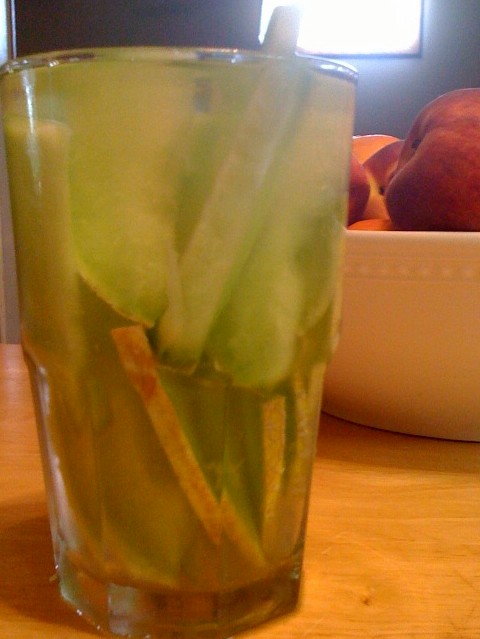 |
| Lemon Drop Melon Water |
The whole point of my nonsensical ramblings is.... in the wise words of Yo Gabba Gabba......
TRY IT, YOU'LL LIKE IT!
Try new foods, expand your horizons, buy that crazy looking/sounding fruit. You never know if you will like it if you never try it.
Ok, so now that I have wasterd 30 minutes of my afternoon writing this and a good 5 minutes of your afternoon as you read this I guess I will go and do something a little more productive.
Love,
this fun fruit lovin' mama,
Christy
P.S. Check out my new blog called More Exotic Melons for a little more info on this melon and several other new (to me) melons I discovered.
UPDATE 08/01/11
Check out the comment that Sarah left, she works in the produce department at a grocery store and had some great info to share, thank you so much Sarah! Also, I just bought a Lemon Drop Melon a few days ago and used it for smoothies, I will be posting the recipe soon, it was YUM YUM YUM! Be on the look out for that, I will link it here when it is up.
"Hi! My name is Sarah and I just stumbled across your blog here for the first time, and I'm hoping I can be of a little bit of help. I work for a grocery store in the produce section and it's my job to find out more information to pass on to customers and it just so happens that the Lemon Drop melon is what I'm looking at this week, and I'm happy to share the information that we found.
First off, the Galia Melon and the Lemon Drop Melon (a.k.a. Lemon Melon) are NOT the same melon.
The Lemon Melon came about only in the last few decades from a melon breeder in the Mediterranean region. He originally found a melon that was naturally high in citric acid, which is what gives the Lemon Melon it's lemony taste. Over the next decade or two after it's discovery, it was bred with many sweet-type melons using traditional breeding techniques (Non-GMO) to get the delicious melon that we have today.
As far as nutrition goes, the Lemon Drop Melon is fat free, low in calories (60 calories/cup) and high in Vitamins A and C.
To Sarah: I don't have twitter, I am not "cool" like that and find new technology intimidating. I am on Facebook
Also, I got a notification a few days ago that someone left a comment on More Exotic Melons telling a trick on how to know if the Lemon Drop Melon is ripe. I know many of you are wondering this, however when I go back and look the comment was gone. I remember he said something about the green lines in the rind being dark in color but that's it. So Sorry, I have never been good at how to tell if any melons are ripe. I usually just grab 1, I have not been disappointed yet.
You can feel free to contact me on my personal twitter account, which is sarahwells61 if you have any more questions. Hope this helped! "
Subscribe to:
Posts (Atom)
